

Open vs Closed Rhinoplasty in Armenia: High-Quality Results at a Competitive Price.
Rhinoplasty is one of the most popular facial plastic surgery procedures in Armenia and internationally. For some patients, the goal is primarily aesthetic: reducing a nasal hump, refining the tip, narrowing the nose, or improving facial proportions. For others, rhinoplasty also has a functional purpose, such as improving nasal breathing or correcting structural problems of the septum.
For international patients, Armenia has become an increasingly attractive destination for rhinoplasty because it combines experienced surgeons, comparatively accessible prices, modern medical facilities, and the convenience of receiving coordinated support throughout the treatment journey.
At HEG, rhinoplasty is approached as an individualized surgical procedure rather than a standard operation performed according to a fixed template. Every nose has different anatomy, skin characteristics, cartilage structure, previous surgical history, and aesthetic requirements. Therefore, the surgical technique—including whether an open or closed approach is appropriate—should be determined after an assessment by the surgeon.
This guide explains what rhinoplasty in Armenia involves, the difference between closed and open rhinoplasty, how much the procedure costs, what international patients should expect, and why HEG can be a convenient choice for patients considering surgery in Armenia.
What Is Rhinoplasty?
Rhinoplasty is a surgical procedure designed to change the shape, proportions, and structure of the nose. Depending on the patient’s needs, surgery may address the nasal bridge, tip, nostrils, septum, or other structural components of the nose.
Although rhinoplasty is often described as cosmetic surgery, it can also have a functional component. Structural abnormalities of the nose or a deviated septum may contribute to breathing difficulties, and in selected cases rhinoplasty can be combined with septoplasty or other functional procedures.
A successful rhinoplasty should take into account both appearance and function. The objective is not simply to make the nose smaller. Instead, the surgeon evaluates how the nose relates to the forehead, cheeks, lips, chin, and overall facial proportions.
This is particularly important because a result that looks attractive on one face may not look natural on another.
At HEG, patients are evaluated individually, and the recommended surgical plan depends on the anatomy of the nose, the patient’s expectations, and the complexity of the correction. HEG’s rhinoplasty information also emphasizes assessment of both the internal and external structures of the nose before selecting the appropriate technique.
Primary and Secondary Rhinoplasty
Before discussing open and closed rhinoplasty, it is important to distinguish between primary and secondary rhinoplasty.
Primary rhinoplasty
Primary rhinoplasty means that the patient has not previously undergone rhinoplasty surgery. It may involve changes to the bridge, tip, nostrils, nasal bones, septum, or several structures simultaneously.
Primary surgery can range from relatively straightforward corrections—for example, removing a small hump—to complex structural reshaping.
Secondary or revision rhinoplasty
Secondary rhinoplasty is performed when the patient has previously undergone nasal surgery and requires additional correction.
Revision rhinoplasty can be more complex because the surgeon is working with anatomy that has already been altered. Scar tissue may be present, cartilage may have been removed or weakened, and additional structural support may sometimes be required.
For this reason, revision surgery should not be considered simply a second version of primary rhinoplasty. It requires careful assessment and often a more reconstructive approach.
HEG currently lists primary and secondary rhinoplasty as separate procedures, with the final price depending on the volume and complexity of the intervention and the selected surgeon.
Closed Rhinoplasty
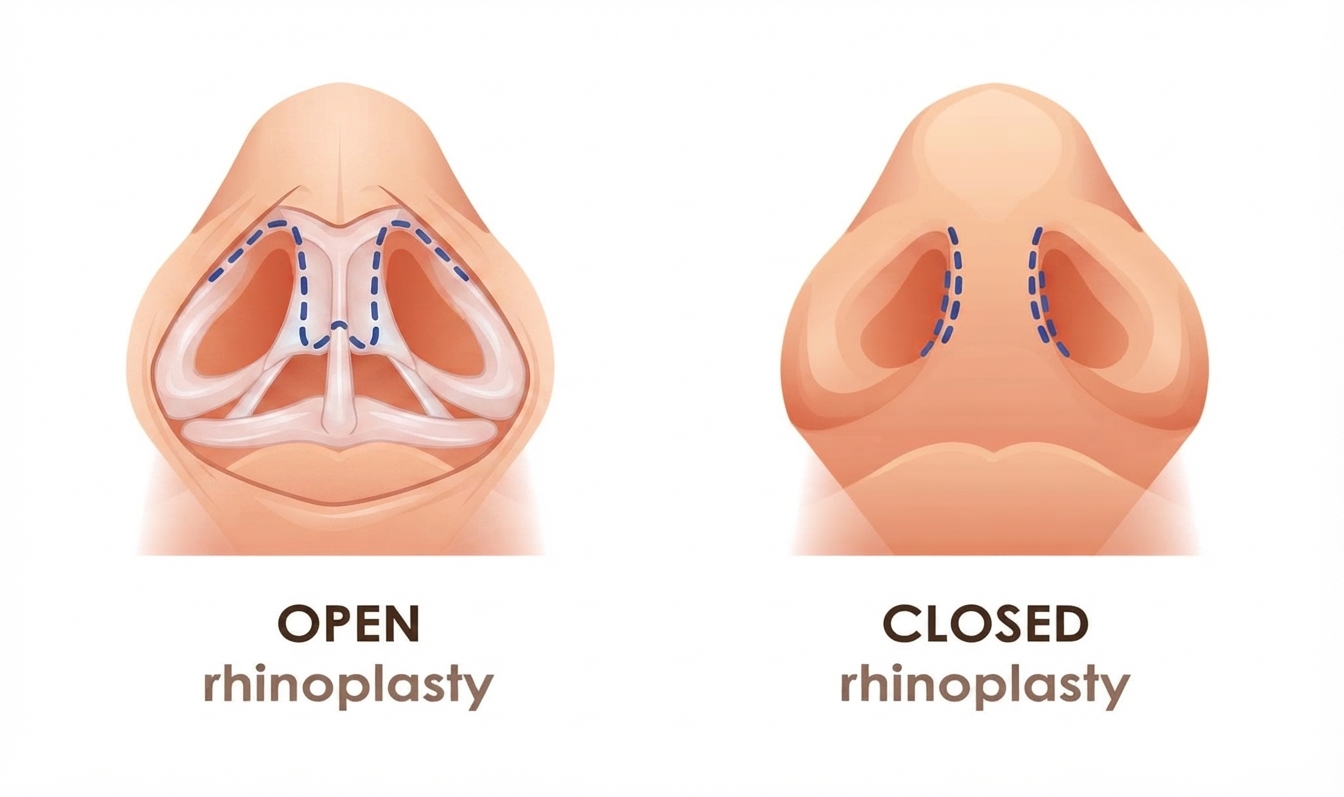
Closed rhinoplasty is performed through incisions located inside the nostrils. Because there is no external incision on the columella—the strip of tissue between the nostrils—there is no visible external surgical scar.
One of the main advantages of the closed approach is that it allows the surgeon to perform appropriate corrections while preserving the external skin of the nose.
Closed rhinoplasty may be suitable for selected patients who require corrections that can be effectively performed through an internal approach. Depending on the anatomy and surgical objectives, this can include certain nasal hump corrections, narrowing procedures, and selected structural or septal corrections.
However, closed rhinoplasty is not automatically the “better” or more modern technique. The approach has limitations in terms of surgical exposure, and the surgeon must determine whether sufficient access is possible to achieve the desired correction.
The American Academy of Facial Plastic and Reconstructive Surgery notes that closed rhinoplasty uses internal incisions and can offer advantages such as the absence of an external scar and, in selected cases, less swelling and a faster early recovery.
Advantages of Closed Rhinoplasty
Potential advantages include:
- No external incision on the columella
- No visible external surgical scar
- Less disruption of some soft tissues
- Potentially less postoperative swelling in selected cases
- Potentially shorter early recovery for appropriate procedures
- Suitable for certain primary rhinoplasty corrections
However, these advantages should always be considered in relation to the patient’s anatomy and the procedure being performed.
A closed approach should never be selected simply because a patient wants “no scar.” If the operation requires greater surgical exposure, choosing a closed technique solely for this reason may not be appropriate.
Open Rhinoplasty
Open rhinoplasty involves all the internal incisions used in rhinoplasty together with a small additional incision across the columella.
Through this incision, the surgeon can gently lift the skin of the nose and obtain a much more direct view of the underlying cartilage and bone.
The main advantage of an open approach is therefore surgical visibility.
According to UCSF’s patient information, open rhinoplasty allows the surgeon to expose the internal structures of the nose, while closed rhinoplasty is performed without the external columellar incision.
This additional access can be particularly useful when significant structural changes are required.
Open rhinoplasty is frequently considered for:
- Complex tip reshaping
- Significant asymmetry
- Structural reconstruction
- Major cartilage modification
- More complicated primary rhinoplasty
- Revision rhinoplasty
- Cases requiring grafts or additional structural support
The small columellar incision is carefully closed at the end of surgery. In most cases, the resulting scar becomes very difficult to notice as it heals.
Advantages of Open Rhinoplasty
The principal advantage is improved visualization of the nasal framework.
This can allow the surgeon to:
- Precisely evaluate the nasal cartilages
- Perform detailed tip reshaping
- Correct asymmetries
- Place structural grafts when necessary
- Reconstruct weakened cartilage
- Make controlled modifications to the nasal framework
This does not mean that open rhinoplasty is inherently superior to closed rhinoplasty. It means that it provides a different level of surgical access.
Recent medical guidance similarly emphasizes that neither technique is universally better; the appropriate approach depends on the anatomy and surgical objectives.
Closed vs. Open Rhinoplasty: What Is the Difference?
The simplest way to understand the difference is to think about access.
With closed rhinoplasty, the surgeon works through internal nasal incisions.
With open rhinoplasty, the surgeon adds a small incision on the columella and temporarily lifts the nasal skin to gain broader access to the underlying framework.
| Feature | Closed Rhinoplasty | Open Rhinoplasty |
|---|---|---|
| Incisions | Inside the nose | Inside the nose + small columellar incision |
| External scar | No | Small scar on the columella |
| Surgical visibility | More limited | Greater |
| Tip reconstruction | Suitable for selected cases | Particularly useful for complex corrections |
| Complex reconstruction | May be limited | Often advantageous |
| Revision surgery | Selected cases | Frequently useful |
| Early swelling | May be less in selected cases | Can be somewhat greater |
| Best choice | Depends on anatomy | Depends on anatomy |
The most important point is that patients generally should not choose the technique themselves based only on internet information.
The surgeon should determine which approach provides the safest and most predictable way to achieve the desired result.
See Closed Rhinoplasty Results
If you are considering a closed rhinoplasty, you can explore real before-and-after results from patients treated by HEG’s specialists. The gallery includes examples of closed rhinoplasty and other nasal procedures, allowing you to better understand the types of aesthetic changes that can be achieved.
View closed rhinoplasty before-and-after results:
Closed Rhinoplasty Results – HEG
Is Closed Rhinoplasty Better Than Open Rhinoplasty?
There is no universal answer.
A common misconception is that closed rhinoplasty is automatically better because there is no external incision. Another misconception is that open rhinoplasty is automatically superior because it gives the surgeon greater visibility.
Neither assumption is correct.
For a patient who needs a relatively limited correction, a closed approach may provide everything the surgeon needs. In another patient, especially someone requiring complex tip reconstruction or revision surgery, the additional visibility of an open approach may be extremely valuable.
The objective should therefore not be to choose the technique with the smallest incision. The objective should be to choose the technique that allows the surgeon to perform the necessary correction appropriately.
As UCSF explains, the patient’s goals and the surgeon’s assessment both play a role in deciding between the two approaches.
Rhinoplasty Prices in Armenia
One of the reasons patients consider Armenia for rhinoplasty is the comparatively accessible cost of treatment.
HEG’s current published price list lists:
- Primary rhinoplasty — from $1,400
- Secondary rhinoplasty — from $1,750
- Septoplasty — from $530
- Nasal tip surgery — from $1,150
The exact cost may vary according to the complexity and volume of the procedure and the surgeon selected.
It is important to understand that an online price should be considered a starting point rather than a personalized quotation.
For example, a patient requiring a relatively straightforward primary rhinoplasty may have a different surgical plan and cost from a patient who requires septal correction, extensive tip reconstruction, grafting, or revision surgery.
Therefore, the final price should be confirmed after the surgeon has evaluated the patient’s case.
What Can Influence the Cost?
Several factors may affect the final cost of rhinoplasty:
- Primary or secondary surgery: Revision rhinoplasty generally requires more complex planning and surgical work than a straightforward primary procedure.
- Surgical complexity: A small dorsal hump correction is very different from comprehensive structural reconstruction.
- Septal correction: If the septum requires correction, septoplasty may be performed together with rhinoplasty when medically appropriate.
- Tip surgery: Some patients require significant modification of the nasal tip, while others need relatively minor changes.
- Cartilage grafting: In complex or revision cases, additional cartilage may be required to provide structural support.
- Choice of surgeon: The surgeon selected and the complexity of the individual case can influence the final price.
For this reason, patients should be cautious when comparing rhinoplasty prices based only on advertisements. A low headline price does not necessarily mean that two surgical packages provide exactly the same procedure.
Why Choose Armenia for Rhinoplasty?
Armenia has become an attractive destination for international patients seeking cosmetic and reconstructive procedures.
There are several reasons patients consider Armenia.
Competitive Pricing
The cost of medical treatment in Armenia can be significantly lower than in many Western European countries and the United States.
This allows international patients to access experienced specialists without necessarily paying the prices associated with major Western medical tourism destinations.
HEG’s published rhinoplasty prices demonstrate this comparatively accessible pricing structure.
However, price should never be the only reason to choose a surgeon or country for surgery.
Experienced Specialists
Rhinoplasty is technically demanding surgery. Experience with different nasal anatomies and different types of corrections is extremely important.
HEG works with a team of plastic, aesthetic, and maxillofacial surgeons and states that its specialists have extensive experience in plastic surgery and international patient care.
Patients can review doctors’ profiles and examples of previous work before making a decision.
Personalized Approach
Every nose is different.
The same surgical technique cannot produce the same plan for every patient. Skin thickness, cartilage strength, nasal bone structure, previous operations, facial proportions, and the patient’s expectations all influence the surgical strategy.
At HEG, the initial assessment is intended to help determine the appropriate procedure and surgical approach for each patient.
Convenient Medical Tourism
Traveling abroad for surgery can seem complicated.
A patient has to think about:
- Finding a surgeon
- Arranging consultations
- Scheduling the operation
- Organizing transportation
- Communicating with the medical team
- Finding accommodation
- Understanding postoperative instructions
- Attending follow-up appointments
A medical coordination company can simplify this process.
HEG provides medical tourism coordination and support for international patients, including assistance with consultations, transfers, and postoperative care.
Why Choose HEG for Rhinoplasty in Armenia?
Choosing the country is only the first step. The next and arguably more important decision is choosing the medical team and the organization that will coordinate the treatment.
HEG specializes in medical tourism and works with international patients who travel to Armenia for different medical procedures.
For rhinoplasty patients, HEG can help coordinate the process from the initial inquiry through surgery and postoperative follow-up.
1. Help Before Arrival
International patients can provide photographs and relevant medical information before traveling.
This allows the medical team to understand the general situation and determine whether an online consultation with the surgeon would be appropriate.
The patient’s goals can also be discussed before the trip.
2. Surgeon Consultation about Open vs Closed Rhinoplasty
The surgeon evaluates the patient’s anatomy and discusses the desired outcome.
This is an essential stage because photographs alone cannot replace a proper medical assessment.
The consultation provides an opportunity to discuss:
- Desired nasal shape
- Breathing concerns
- Previous surgery
- Potential limitations
- Surgical technique
- Expected recovery
- Possible risks
- The approximate cost
3. Coordination in Armenia
For an international patient, having one point of contact can make the experience considerably easier.
HEG’s medical tourism model includes assistance with logistics and communication, helping patients navigate appointments and the treatment process.
4. Postoperative Support
Rhinoplasty does not end when the operation is completed.
The postoperative period is an important part of treatment. Patients may experience swelling, bruising, congestion, and temporary changes in nasal appearance.
Follow-up appointments allow the surgeon to monitor healing and provide postoperative instructions.
Patients traveling from abroad should also plan enough time in Armenia for appropriate postoperative assessment before returning home.
What Does the Rhinoplasty Journey Look Like?
For an international patient, the process can generally be divided into several stages.
- Step 1: Initial Contact — The patient contacts HEG and provides information about their goals, medical history, and previous nasal surgery if applicable.
- Step 2: Photographs — Good-quality photographs from different angles may be requested for an initial assessment (frontal, profile, three-quarter, and basal views).
- Step 3: Online Consultation — If appropriate, an online consultation can be arranged with the surgeon to discuss concerns and expectations in greater detail.
- Step 4: Arrival in Armenia — The patient travels to Yerevan according to the agreed schedule, with HEG assisting in coordination.
- Step 5: In-Person Assessment — The surgeon performs a clinical assessment, confirms the surgical plan, and arranges any additional tests if needed.
- Step 6: Surgery — The operation is performed using the technique selected by the surgeon based on the patient’s anatomy and goals.
- Step 7: Recovery and Follow-Up — The patient remains in Armenia for the necessary postoperative period and attends follow-up appointments.
How Long Does Recovery Take?
Rhinoplasty recovery is a gradual process.
During the first days after surgery, swelling and bruising are common. Nasal congestion can also occur.
The visible appearance of the nose changes significantly during the first weeks, but this does not represent the final result.
Swelling gradually decreases over time, and the nose continues to refine during the following months.
Patients should therefore avoid judging the final result too early.
For international patients, travel planning should always be discussed with the surgeon. The appropriate time to return home depends on the procedure, healing progress, and the surgeon’s assessment.
What Should You Look for When Choosing a Rhinoplasty Surgeon?
Whether you choose Armenia, another European country, or treatment in your home country, the same fundamental principles apply.
- Look at the surgeon’s experience: Rhinoplasty requires specific technical expertise. Look for a surgeon who regularly performs rhinoplasty rather than someone who performs it only occasionally.
- Review real before-and-after results: Before-and-after photographs can help you understand the surgeon’s aesthetic approach, but they should be viewed critically regarding lighting, angles, and editing.
- Discuss function as well as appearance: A nose should not only look appropriate; it should also function properly. Inform the surgeon of any breathing difficulties or previous procedures.
- Be realistic about expectations: Rhinoplasty can significantly change appearance, but it cannot guarantee that a nose will look exactly like a photograph of another person. Harmony with facial features is key.
Rhinoplasty in Armenia: Is It Right for You?
Armenia can be an attractive option for patients who are looking for a combination of experienced specialists, accessible pricing, and organized medical tourism services.
HEG provides an additional layer of coordination for international patients, helping make the process easier to navigate from the initial consultation through postoperative care.
Nevertheless, rhinoplasty remains a surgical procedure, and the decision should be based on medical suitability rather than price alone.
The most important questions are:
- Is the surgeon experienced with the type of rhinoplasty I need?
- Does the surgeon understand my aesthetic goals?
- Can the operation preserve or improve nasal function?
- Do I feel comfortable with the proposed surgical plan?
- Is there an appropriate postoperative follow-up plan?
Once these questions have been answered, the cost and travel arrangements can be considered.
Frequently Asked Questions
Is rhinoplasty in Armenia safe?
Rhinoplasty is a surgical procedure with potential risks, regardless of where it is performed. The important considerations are the qualifications and experience of the surgeon, the medical facility, anesthesia and surgical protocols, patient selection, and postoperative monitoring. Patients should discuss individual risks directly with their surgeon.
Is closed rhinoplasty better than open rhinoplasty?
No. Neither technique is universally better. Closed rhinoplasty may be appropriate for selected cases, while open rhinoplasty can provide greater access for complex structural or tip corrections. The surgeon should choose the approach based on the patient’s anatomy and surgical objectives.
Does open rhinoplasty leave a scar?
Open rhinoplasty includes a small incision on the columella. The incision is closed carefully and generally heals into a subtle scar. Individual healing varies.
How much does rhinoplasty cost in Armenia?
HEG’s published price list currently starts at approximately $1,400 for primary rhinoplasty and $1,750 for secondary rhinoplasty. Septoplasty and nasal tip surgery are listed separately. The final cost depends on the complexity, volume of surgery, and selected surgeon.
Can rhinoplasty and septoplasty be performed together?
Yes, rhinoplasty and septoplasty can be combined when both aesthetic and functional correction are indicated. The surgeon determines whether combined surgery is appropriate after evaluating the patient’s nose.
Can I have rhinoplasty after previous septoplasty?
A previous septoplasty does not automatically prevent a patient from having rhinoplasty. However, previous surgery can change the nasal anatomy and available cartilage, so a detailed assessment is particularly important.
How many days should I stay in Armenia?
The appropriate length of stay depends on the surgical procedure and your individual recovery. International patients should plan their trip according to the surgeon’s postoperative recommendations rather than booking an immediate return flight.
Final Thoughts
Choosing rhinoplasty is a personal decision, and choosing where to have surgery is equally important.
Armenia offers international patients an interesting combination of experienced medical specialists, comparatively affordable prices, and a growing medical tourism infrastructure. For patients considering rhinoplasty, the country can provide access to both primary and complex nasal surgery without the costs commonly associated with some Western destinations.
The distinction between closed and open rhinoplasty is also important, but patients should not approach the decision as a competition between two techniques. Closed rhinoplasty offers internal access without an external columellar incision, while open rhinoplasty provides greater visibility of the nasal framework through a small additional incision. The right choice depends on the anatomy and objectives of the individual patient.
At HEG, the process is designed around the patient rather than a one-size-fits-all surgical model. From the initial assessment and surgeon consultation to coordination in Armenia and postoperative follow-up, the goal is to make the medical journey as organized and comfortable as possible.
If you are considering rhinoplasty in Armenia, the first step is to have your case evaluated. By providing clear photographs and information about your medical and surgical history, you can begin discussing your goals with the medical team and determine which type of rhinoplasty may be appropriate for you.
HEG — Medical Tourism in Armenia, connecting international patients with experienced Armenian medical specialists and helping coordinate the complete treatment journey.