

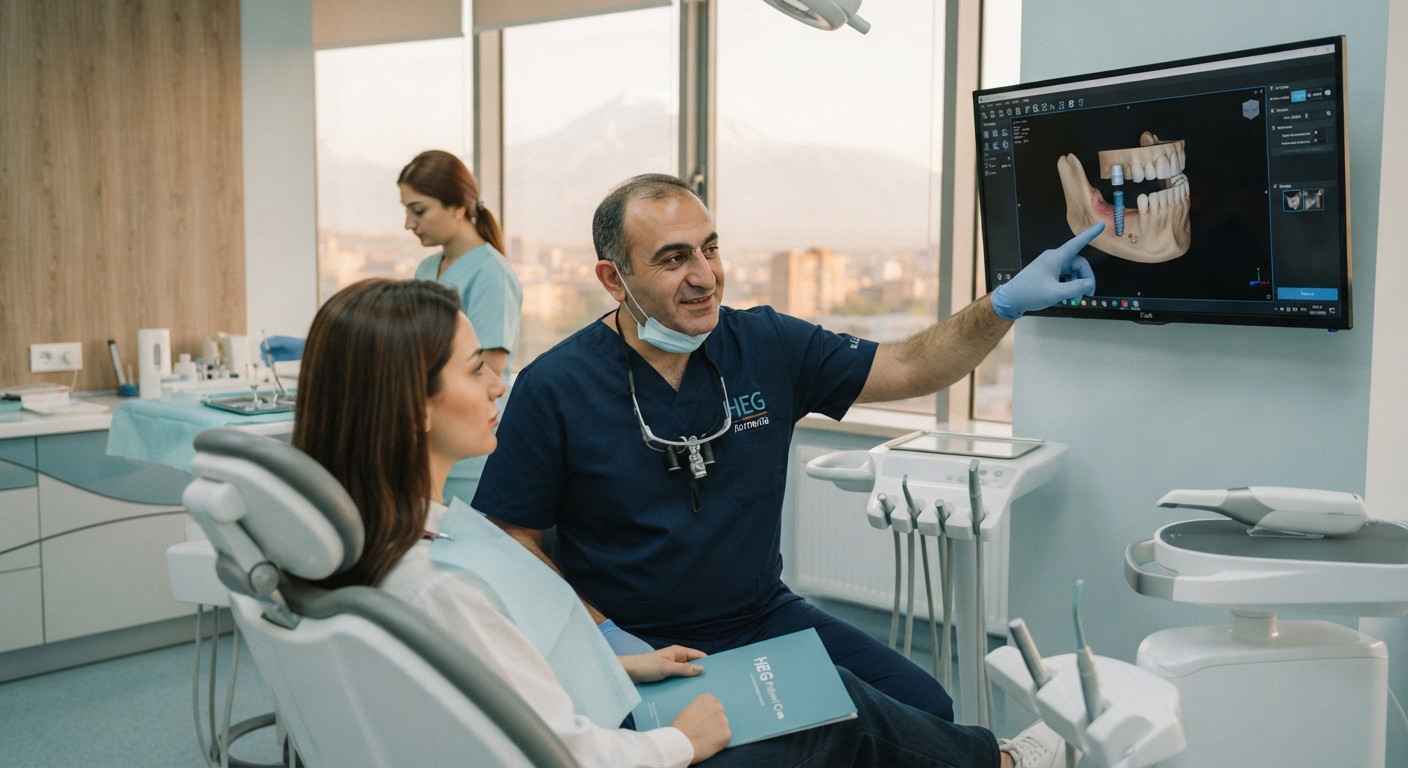
Dental Implants in Armenia: Expanding Your Dental Tourism Experience. A Deep Dive into Technology, Longevity, and Comprehensive Care with HEG
When considering dental implants, it is natural to look beyond the initial treatment price and ask more important questions: How long will dental implants last? What technologies are used in Armenian dental clinics in 2026? Are internationally recognized implant systems available? How safe is treatment abroad? And how can a medical tourism coordinator help protect my health, time, and investment?
These questions are especially important when treatment involves dental implants, full-mouth rehabilitation, crowns, veneers, bone grafting, or complex restorative procedures. Dental treatment is not simply about purchasing a service in another country. It involves diagnosis, treatment planning, surgery, healing, laboratory work, follow-up care, and long-term maintenance.
Armenia has become an increasingly attractive destination for international dental patients because it combines experienced dental professionals, modern clinical technology, internationally recognized materials, and comparatively competitive treatment costs. At the same time, patients can benefit from the country’s rich cultural heritage, convenient city environment, hospitality, and relatively compact geography.
For international patients working with HEG (Healthcare Excellence Group), the experience can extend beyond arranging an appointment. The objective is to create a coordinated journey in which medical assessment, treatment planning, travel logistics, communication, and follow-up are considered together.
In this comprehensive guide, we explore the science behind dental implants, the technologies available in modern Armenian dentistry, the materials and implant systems patients may encounter, the recovery process, the importance of personalized treatment planning, and how professional coordination can make dental tourism more predictable and comfortable.
The Science Behind Dental Implants: Why They Are a Long-Term Investment
Dental implants have transformed modern restorative dentistry. Unlike traditional removable dentures, an implant is designed to replace not only the visible part of a missing tooth but also its functional root.
A conventional dental bridge can restore the appearance and function of a missing tooth, but it generally relies on neighboring teeth for support. This may require preparing otherwise healthy adjacent teeth. Dentures, meanwhile, can provide an effective solution for many patients, but some people experience movement, discomfort, difficulty chewing, or reduced confidence when speaking or eating.
Dental implants approach tooth replacement differently.
An implant typically consists of three main components:
- The implant fixture, which is placed into the jawbone.
- The abutment, which connects the implant to the restoration.
- The crown or prosthetic tooth, which recreates the visible portion of the tooth.
The implant fixture is commonly manufactured from titanium, although other materials, such as zirconia, may be considered in selected situations.
The key biological process that makes implant dentistry possible is called osseointegration. Following implant placement, the surrounding bone gradually integrates with the implant surface. Once sufficient healing has occurred, the implant can provide a stable foundation for a dental restoration.
This process is one of the major reasons implants can provide a highly stable alternative to removable tooth replacement.
Why Bone Preservation Matters
To understand another important advantage of implants, it is useful to understand what happens after tooth loss.
Natural teeth transmit mechanical forces to the surrounding jawbone. When a tooth and its root are lost, that stimulation is significantly reduced. Over time, the bone in the area may gradually resorb.
Bone loss can affect the dimensions of the jaw and may complicate future implant placement. It can also influence the appearance of the lower face, particularly when multiple teeth have been missing for an extended period.
Because an implant is placed into the jawbone and functions as an artificial tooth root, it can help provide functional stimulation to the surrounding bone. However, patients should understand that implants do not automatically prevent every form of bone loss, and individual outcomes depend on factors such as bone quality, periodontal health, oral hygiene, smoking status, systemic health, implant position, and long-term maintenance.
This is why professional diagnosis and individualized treatment planning are essential.
How Long Do Dental Implants Actually Last?
One of the most common questions asked by dental tourism patients is simple: “How many years will my implants last?”
There is no single number that applies to every patient.
Dental implants can remain functional for many years, and some patients successfully maintain their implants for decades. However, the longevity of an implant depends on both biological and mechanical factors.
Important factors include:
- The quality and quantity of available bone
- Correct implant positioning
- The patient’s periodontal health
- Oral hygiene
- Smoking
- Diabetes and other medical factors
- The quality of the prosthetic restoration
- Bite forces and bruxism
- Regular professional dental examinations
- Proper maintenance of the implant and crown
It is therefore more accurate to describe implants as a long-term treatment solution rather than guaranteeing that they will last a lifetime.
The visible crown may require replacement before the implant itself. Crowns are exposed to everyday chewing forces and can eventually experience wear, chipping, staining, or other damage. The implant fixture, if successfully integrated and properly maintained, can potentially remain functional for a much longer period.
For this reason, patients should not view implant treatment as something that ends when the permanent crown is placed. Long-term maintenance is an essential part of protecting the investment.
Advanced Dental Technology in Yerevan Clinics
One misconception sometimes associated with medical tourism is that lower treatment costs automatically mean outdated equipment.
This is not necessarily the case.
Modern Armenian dental clinics serving international patients can use sophisticated diagnostic, surgical, digital dentistry, and laboratory technologies. Through HEG, patients can be directed toward clinics and specialists according to their individual treatment requirements rather than choosing a clinic based on price alone.
Technology is particularly important in implant dentistry because successful treatment depends on accurate diagnosis and precise planning.
1. 3D CBCT Imaging and Digital Diagnostics for Dental Implants in Armenia
Cone Beam Computed Tomography (CBCT) has become an important diagnostic tool in modern implant dentistry.
Traditional two-dimensional dental X-rays provide valuable information, but complex implant cases often require a three-dimensional understanding of the patient’s anatomy.
CBCT can provide detailed images of:
- The jawbone
- Tooth roots
- The position of important nerves
- Sinus anatomy
- Bone dimensions
- Areas of previous dental treatment
- Potential infection or pathology
- The available space for implant placement
This information allows the dental team to assess whether there is enough bone for implant placement and determine whether additional procedures may be necessary.
For example, a patient who has been missing an upper molar for many years may have experienced bone loss combined with expansion of the maxillary sinus. In such a case, the treatment plan may require a sinus lift or bone augmentation before, or sometimes in conjunction with, implant placement.
Without appropriate imaging, these anatomical considerations may be difficult to evaluate accurately.
2. Digital Treatment Planning for Dental Implants in Armenia
Modern implant dentistry increasingly relies on digital treatment planning.
After obtaining three-dimensional imaging and digital impressions, the dental team can create a virtual representation of the patient’s mouth. Implant positions can then be evaluated digitally before surgery.
This approach allows the clinician to consider factors such as:
- Implant angle
- Implant depth
- Available bone
- Distance from anatomical structures
- Prosthetic requirements
- The planned position of the future crown
The goal is not simply to place an implant where bone happens to be available. Ideally, the implant position should also support the functional and aesthetic requirements of the final restoration.
This is particularly important in the visible front teeth, where the position of the implant can influence the appearance of the gum line, crown emergence profile, and overall smile.
3. Computer-Guided Implant Surgery
In appropriate cases, digital planning can be combined with a customized surgical guide.
A surgical guide helps the dentist translate the digitally planned implant position into the clinical procedure. It can provide guidance regarding the intended location, angle, and depth of implant placement.
Computer-guided surgery does not eliminate the need for clinical judgment. Rather, it provides another tool that can improve planning and procedural precision when used appropriately.
Not every patient requires guided surgery, and the decision should be made by the treating implantologist based on the complexity of the case.
4. Digital Impressions
Digital intraoral scanners have also changed the patient experience.
Instead of relying exclusively on traditional impression materials, a dentist may use an intraoral scanner to create a digital model of the patient’s teeth.
Digital impressions can be useful for designing:
- Crowns
- Bridges
- Veneers
- Implant-supported restorations
- Full-arch prostheses
- Bite and occlusion records
For international patients, digital workflows can also make communication between the dental clinic and laboratory more efficient.
5. CAD/CAM Dental Laboratories
Computer-Aided Design and Computer-Aided Manufacturing, commonly known as CAD/CAM, have become fundamental technologies in modern dental laboratories.
A digital scan can be used to design a restoration on specialized software. Depending on the clinic and laboratory setup, the restoration can then be milled from materials such as zirconia or other dental ceramics.
Digital workflows can improve consistency and precision while reducing certain stages of traditional laboratory work.
For international patients, this can be particularly valuable because travel schedules may be limited. Efficient coordination between the dental clinic, laboratory, and patient can help minimize unnecessary delays.
However, complex treatment still requires sufficient time for clinical evaluation, laboratory fabrication, fitting, adjustment, and quality control.
Premium Implant Brands Available in Armenia
Another important consideration for international dental patients is the implant system being used.
Implants are not all identical. Different manufacturers offer different implant designs, surface technologies, prosthetic components, digital workflows, and clinical documentation.
Depending on the clinic and clinical indication, patients may encounter internationally established brands such as:
Straumann
Straumann, headquartered in Switzerland, is one of the best-known names in implant dentistry. The company has a long history of research and development in implantology and offers a broad portfolio of implant and prosthetic solutions.
Straumann systems are often selected for their extensive clinical documentation, engineering, and established global presence.
Nobel Biocare
Nobel Biocare is another major international implant company with a long history in implantology and restorative dentistry.
The company is strongly associated with the development and popularization of advanced implant treatment concepts, including solutions for patients requiring full-arch rehabilitation.
Megagen
Megagen, based in South Korea, has developed a significant international presence in implant dentistry. Its product portfolio includes implant systems designed for a range of clinical situations.
Osstem
Osstem is another major South Korean implant manufacturer with an international market presence. Its systems are used in numerous countries and are available in different configurations for various implant indications.
The choice of implant brand should not be based exclusively on brand recognition. A qualified implantologist should consider the patient’s anatomy, treatment goals, bone condition, prosthetic requirements, previous dental work, and long-term maintenance needs.
The availability of replacement components is also worth considering for international patients. A globally established implant system can be advantageous because compatible prosthetic components and professional support may be easier to access in different countries.
Dental Treatment Is About More Than the Implant
An important point for international patients is that the implant itself is only one component of the treatment.
Before implant placement, the dental team must determine whether the mouth is healthy enough for surgery.
Existing issues such as:
- Gum disease
- Active infection
- Tooth decay
- Poor oral hygiene
- Inadequate bone volume
- Sinus-related anatomical limitations
- Uncontrolled bite problems
may need to be addressed first.
This is particularly important for patients considering full-mouth rehabilitation.
A person may travel to Armenia expecting to receive several implants, only to discover during examination that certain teeth can be preserved. In other cases, a tooth that initially appears suitable for restoration may have a poor long-term prognosis and require extraction.
The objective should therefore never be “as many implants as possible.”
The objective should be the most appropriate treatment plan for the patient’s long-term oral health.
Bone Grafting and Additional Procedures
Some patients have insufficient bone volume for conventional implant placement.
This does not necessarily mean implants are impossible.
Depending on the location and anatomy, the dentist may consider procedures such as:
- Guided bone regeneration
- Bone grafting
- Sinus augmentation
- Ridge augmentation
- Soft-tissue grafting
These procedures can increase the complexity and duration of treatment.
For example, the upper posterior jaw can present unique challenges because the maxillary sinus may occupy a large portion of the available space after tooth loss.
A sinus lift can sometimes create additional vertical bone volume, allowing implant placement when conventional placement would otherwise be difficult.
However, not every patient requires bone augmentation, and the need can only be established after appropriate imaging and clinical assessment.
All-on-4 and Full-Arch Dental Rehabilitation
Patients who have lost most or all of their teeth often ask about All-on-4 or similar full-arch implant solutions.
These treatments are designed to support an entire arch of prosthetic teeth using a limited number of strategically positioned implants.
The concept can provide an alternative to conventional removable dentures for appropriately selected patients.
However, full-arch treatment is significantly more complex than replacing a single tooth.
It requires careful assessment of:
- Bone anatomy
- Bite
- Facial proportions
- Gum health
- Existing restorations
- Implant positions
- Prosthetic design
- Long-term maintenance
A temporary restoration may be provided while the implants heal, followed by a definitive prosthesis once the appropriate healing and clinical milestones have been reached.
Patients should always receive an individualized treatment plan rather than assuming that a particular technique is automatically appropriate for everyone.
What to Expect During Dental Implantation Surgery
Dental implant placement is generally performed under local anesthesia, although additional sedation options may be available depending on the clinic and patient’s needs.
During the procedure, the dentist prepares the implant site and places the implant fixture into the jawbone.
The duration depends on the number of implants, anatomical complexity, additional procedures, and treatment strategy.
Patients commonly experience some degree of swelling, tenderness, or discomfort after surgery. These symptoms are usually managed according to the dentist’s postoperative instructions.
One of the most important points is that pain during surgery should not be expected when appropriate anesthesia is used.
However, every patient responds differently, and postoperative discomfort can vary depending on the extent of treatment.
Following the procedure, patients receive instructions regarding:
- Oral hygiene
- Diet
- Physical activity
- Medication
- Swelling management
- Warning signs
- Follow-up appointments
International patients should carefully follow these instructions and contact the dental team if they experience unexpected symptoms.
Understanding the Osseointegration Period
After implant placement, the body needs time to integrate the implant with the surrounding bone.
This biological process is known as osseointegration.
The healing period varies from patient to patient and can depend on:
- Bone quality
- Implant location
- Implant stability
- Whether bone grafting was performed
- General health
- Surgical complexity
- The dentist’s treatment protocol
In many cases, several months may be required before the implant is ready to support the final restoration.
This is one reason why dental tourism treatment cannot always be completed in a single short visit.
Some patients may qualify for immediate loading or same-day temporary teeth, while others require a staged treatment plan.
The decision should be based on clinical evidence and the patient’s specific circumstances rather than on the promise of completing every procedure within a fixed number of days.
Turning Recovery Time Into a Travel Experience
One of the unique advantages of dental tourism in Armenia is the opportunity to combine treatment with travel.
Yerevan provides international visitors with restaurants, cafes, museums, historical landmarks, and a lively urban atmosphere. Patients who are medically cleared for normal activities can explore the city around their treatment schedule.
For those who prefer a quieter environment, destinations such as Dilijan offer forests, nature, and a slower pace, while Jermuk is known for its mineral-water traditions and spa environment.
However, patients should remember that tourism activities must be adapted to the treatment stage.
Immediately following oral surgery, strenuous physical activity, long excursions, excessive sun exposure, and certain foods or beverages may be discouraged.
The priority should always be recovery.
A well-organized dental tourism journey therefore balances clinical appointments with appropriate rest rather than treating the entire trip as a conventional vacation.
Why Coordination Matters in Dental Tourism
Traveling abroad for dental treatment can be stressful when the patient has to organize everything independently.
There may be questions about:
- Which dentist should I choose?
- Which clinic is appropriate for my case?
- What implant system will be used?
- How many days should I stay?
- Do I need a CBCT scan?
- Will I need bone grafting?
- When can I fly home?
- Where should I stay?
- How will I get to the clinic?
- What happens if the treatment plan changes?
This is where a medical tourism coordinator can provide significant value.
HEG works to connect international patients with appropriate medical professionals and coordinate the different elements of their treatment journey.
Instead of treating the dental procedure as an isolated appointment, the process can be organized as a complete patient pathway.
The HEG Patient Journey for Dental Implants in Armenia
The process generally begins with an initial inquiry.
The patient can provide information about their dental concerns, previous treatments, medical history relevant to the procedure, and desired outcome. Existing dental X-rays, CBCT scans, photographs, or treatment plans can also be reviewed when available.
Based on the available information, the case can be discussed with an appropriate dental specialist.
The next stage may involve:
- Preliminary case assessment
- Selection of a suitable specialist
- Diagnostic imaging
- In-person consultation
- Final treatment planning
- Cost estimation
- Appointment scheduling
- Treatment
- Postoperative monitoring
- Follow-up and coordination
The exact process depends on the treatment required.
For patients traveling internationally, this structured approach can reduce uncertainty and help them understand what will happen before they arrive.
Transparent Treatment Planning and Costs
Price is understandably one of the main reasons patients investigate dental tourism.
However, the lowest advertised price is not necessarily the best value.
A dental treatment quote should be evaluated based on what is actually included.
For example, patients should ask whether the quoted price includes:
- Consultation
- Imaging
- Implant placement
- Abutment
- Crown
- Temporary restoration
- Bone grafting, if required
- Anesthesia
- Laboratory fees
- Follow-up appointments
A transparent treatment proposal makes it easier to compare options accurately.
At HEG, the goal is to provide patients with a clear understanding of the recommended treatment and associated costs before they commit to traveling.
Nevertheless, patients should understand that a preliminary estimate may change if an in-person examination reveals previously unknown clinical conditions.
This is especially important in complex dental cases.
Communication Is Part of Patient Safety
Language barriers can create unnecessary stress during medical treatment.
International patients may have difficulty explaining previous procedures, allergies, medications, symptoms, or expectations in an unfamiliar healthcare environment.
A dedicated coordinator can help facilitate communication between the patient and medical team.
For patients working with HEG, communication and logistical support can extend from the initial inquiry through the treatment process.
This can include helping patients understand appointment schedules, clinic locations, treatment stages, and practical instructions.
The goal is simple: the patient should know where they need to be, what is happening next, and who they can contact if they have questions.
Why Choosing the Right Dentist Matters More Than Choosing the Cheapest Implant
A premium implant brand alone cannot guarantee a successful outcome.
The quality of the clinical result depends on multiple factors, including diagnosis, treatment planning, surgical technique, prosthetic design, laboratory work, and maintenance.
The experience of the treating dental professional is therefore crucial.
Patients should consider:
- The dentist’s qualifications
- Experience with the specific procedure
- Before-and-after clinical cases
- Treatment planning philosophy
- Diagnostic approach
- Implant systems used
- Laboratory collaboration
- Follow-up protocols
For complex cases, it can also be valuable to obtain a professional opinion before traveling.
HEG’s role is to help patients navigate these decisions and connect them with appropriate specialists rather than simply selecting a provider based on a single advertised price.
The Importance of Long-Term Maintenance
Even the most advanced implant system requires maintenance.
Patients should continue regular dental examinations after returning home.
Professional cleaning may be recommended at intervals based on individual risk. The dentist should also evaluate the implant, surrounding tissues, crown, bite, and overall oral hygiene.
At home, patients should maintain careful brushing and interdental cleaning according to their dentist’s instructions.
Patients with a history of gum disease may require particularly careful monitoring because inflammation around implants can compromise the tissues supporting them.
Long-term success is therefore a partnership between the dentist and the patient.
The treatment does not end when the final crown is fitted.
Dental Tourism in Armenia: Combining Quality, Convenience, and Experience
Armenia offers an interesting combination for international dental patients.
The country has a growing private healthcare sector, experienced dental professionals, modern clinics, and competitive treatment costs. At the same time, Armenia is a culturally rich destination where patients can experience architecture, cuisine, history, nature, and hospitality.
For many international visitors, the ability to receive dental treatment while staying in a compact capital city is an additional advantage.
Yerevan’s concentration of medical and hospitality services makes it possible to coordinate appointments, accommodation, transportation, and leisure activities without the logistical challenges associated with larger countries.
For patients undergoing extensive treatment, this can make the overall experience more manageable.
Is Dental Tourism in Armenia Right for You?
Dental tourism is not appropriate for every patient or every procedure.
A patient should consider several factors before deciding to travel.
These include:
- The complexity of the treatment
- The expected number of visits
- Healing requirements
- Travel distance
- Follow-up arrangements
- Existing medical conditions
- Previous dental treatment
- The availability of diagnostic records
- The patient’s ability to return for subsequent appointments if necessary
Simple procedures may be easier to organize during a short visit, while full-mouth rehabilitation or complex implant cases may require multiple stages.
The safest approach is to obtain an individualized medical assessment before making travel arrangements.
Why Choose HEG for Dental Implants in Armenia?
The role of a medical tourism company should not be limited to booking a dental appointment.
The real value lies in coordination.
HEG helps international patients navigate the process from the first inquiry through treatment and follow-up.
This can involve matching the patient with a suitable specialist, organizing consultations, coordinating appointments, assisting with transportation, helping with accommodation arrangements, and maintaining communication throughout the journey.
For a patient who is unfamiliar with Armenia, this support can significantly reduce the administrative burden.
Instead of spending weeks trying to understand different clinics, treatment packages, prices, and schedules independently, patients can receive structured assistance throughout the process.
Your Smile Is a Long-Term Investment
Dental implants, crowns, bridges, veneers, and full-mouth rehabilitation are not ordinary purchases.
They affect your health, appearance, confidence, comfort, and quality of life.
That is why the right question is not simply:
“Where can I get the cheapest dental implants?”
A better question is:
“Where can I receive an appropriate treatment plan from qualified professionals, using suitable materials and technology, with reliable coordination and long-term support?”
For international patients, Armenia can offer an attractive combination of professional dental care and accessible medical tourism services.
With the right specialist, appropriate diagnostics, high-quality materials, careful treatment planning, and responsible long-term maintenance, dental implants can provide a durable and natural-looking solution for missing teeth.
Ready to Transform Your Smile?
Your smile plays an important role in how you communicate, eat, speak, and interact with the world. Missing or damaged teeth can affect much more than appearance. They can influence chewing function, confidence, oral health, and, in some cases, the condition of the surrounding bone and teeth.
Modern dentistry provides more options than ever before.
From single-tooth implants and crowns to veneers, bridges, All-on-4 solutions, and comprehensive full-mouth rehabilitation, treatment can be tailored to the individual patient.
Armenia’s modern dental clinics, experienced specialists, digital technologies, and competitive treatment environment make it an increasingly interesting destination for international patients considering restorative and cosmetic dentistry.
At the same time, the most important factor should always remain patient safety and treatment quality.
HEG helps international patients navigate this process by coordinating communication between patients and medical professionals and assisting with the practical aspects of traveling to Armenia for treatment.
Whether you are replacing a single missing tooth, considering several dental implants, planning a complete smile transformation, or exploring full-mouth rehabilitation, the first step is a professional evaluation.
Your treatment should be built around your anatomy, oral health, expectations, and long-term needs—not around a generic package.
If you are considering dental treatment in Armenia in 2026, begin with your dental records, recent X-rays or CBCT scans if available, and a clear description of your concerns. From there, the appropriate specialist can assess your case and help determine the most suitable treatment pathway.
Your journey to a healthier and more confident smile can begin with a consultation—and with the right planning, dental treatment can become part of a carefully organized and comfortable experience in Armenia.
For international patients, HEG can help coordinate the next steps, connect you with appropriate dental specialists, and assist with organizing the medical and travel aspects of your journey.
Explore HEG’s dental services and contact the team to discuss your individual treatment requirements and receive a personalized treatment plan.